
 0345 224 3691



 Enjoy the May Bank Holiday!

Price Match
We guarantee our prices are extremely competetive and should be the BEST prices you will find on-line, along with delivering the very best service. For this reason, we offer a price match against other on-line sellers. If you find the same product elsewhere on line, give us a call on 0345 224 3691 and we will match or even beat it! Note that the following conditions must be met for the price match to apply:
- The item must be available on a UK website at the advertised price, and readily available to purchase, with a like for like delivery offering.
-The item in question must have the same specifications, quantity and be produced by the same manufacturer - although we will usually price match even if made by a different manufacturer, as long as its a comparable quality.
- Auction sites such as ebay and amazon do not qualify for price match.
- The price match cannot be used in conjunction with any discount codes or promotional items.
- If there are pricing errors on competitors sites that are clear typographical pricing errors, these will not be matched.
- Note that for corrugated lines (boxes/cartons), the item must be of the same specification (fluting and thickness) and be unbranded.
Call us on 0345 224 3691 and we will be more than happy to help!
Paper vs Plastic Packing Tape: Environmental Impact, Strength & Price
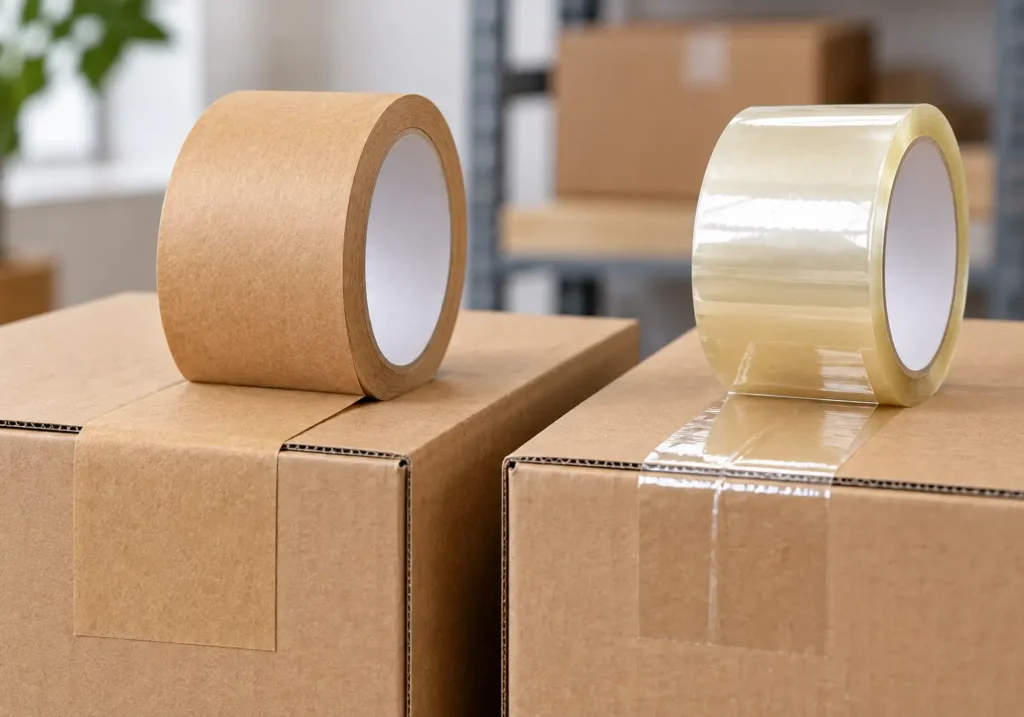
Key Takeaways
-
Paper tape suits eco-conscious packing and tamper-evident sealing, while plastic tape handles moisture, fast packing, and demanding logistics conditions better.
-
Plastic tape flexes under pressure and resists humidity, while water-activated paper tape, including reinforced versions, bonds into cardboard fibres for strong seals on corrugated boxes.
-
Paper tape’s kraft backing can be recycled alongside cardboard in some systems, depending on the adhesive and coatings, while plastic tape usually needs to be removed from the box first.
-
Across pack sizes from 6 to 360 rolls, clear plastic tape costs £0.50 to £0.83 per roll, while brown kraft paper tape costs £1.61 to £2.16 per roll.
-
At Globe Packaging, we stock brown kraft paper tape and clear plastic tape with same-day dispatch on orders placed by 4pm, so you can test both before setting up your packing line.
Where Paper and Plastic Tape Each Come Out Ahead
Plastic tape generally wins on flexibility and cost per roll, while paper tape wins on recyclability and tamper-evident sealing, so the better choice depends on what you ship and how. Getting it wrong can lead to seals failing in transit, higher costs per parcel, or extra handling at the recycling stage because the adhesive does not separate during pulping.
The decision also hinges on details that are easy to overlook, such as whether paper tape is pressure-sensitive or water-activated and how it holds up in damp storage. Price matters too, since paper tape costs roughly 2.6–3.2 times more per roll depending on pack size.
Globe Packaging stocks brown kraft paper tape in packs from 6 to 360 rolls and clear plastic tape in packs from 6 rolls upwards, so you can match the tape to each packing job and order volume.



Paper vs Plastic Tape: An Overview
What Is Paper Packing Tape?
Paper packing tape has a kraft-paper backing and comes in two adhesive formats. Pressure-sensitive tape sticks on contact and goes straight from the roll onto the box.
Water-activated tape must be wetted before use, usually with a dedicated dispenser, though a damp sponge or cloth works for low volumes; it then fuses to the cardboard surface for an especially strong bond with corrugated board.
What Is Plastic Packing Tape?
Plastic packing tape is typically made from biaxially oriented polypropylene (BOPP) film with an acrylic, hot-melt, or solvent-based adhesive.
This combination gives it flexibility and pull strength, making it the default tape in warehouses, factories, and logistics centres. For high-volume packing stations, ProLoc low-noise tape in clear and brown (48mm x 66m) uses a low-noise adhesive designed for fast-paced packing. It also comes in more finishes than paper tape, including clear, brown, coloured, and printed versions.
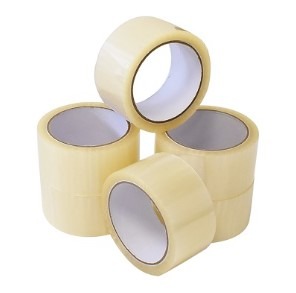
Clear plastic tape resists water and humidity better than standard paper tape.
Differences in Tape Strength
Tensile Strength and Flexibility
Plastic packing tape generally offers excellent tensile strength and flexibility, meaning it tolerates stretching, twisting, and changes in carton shape without snapping or peeling. That flexibility is particularly useful in demanding logistics conditions, where boxes get compressed, stacked, and jostled repeatedly before they reach their destination.
Standard paper tape is less flexible than plastic tape and can tear more easily under heavy pressure. This is because paper does not stretch the way a polypropylene film does, so it has less give when a carton is squeezed or knocked in transit.
Performance on Corrugated Boxes
Paper tape is not automatically the weaker option once you move into water-activated formats. Water-activated tape, including reinforced versions, can deliver strong carton-sealing performance on corrugated boxes, because the adhesive bonds directly with the cardboard fibres.
Plastic packing tape seals corrugated boxes with an adhesive that sits on the surface of the cardboard rather than bonding with its fibres. Because the bond is less permanent, heavier cartons and long-distance shipments may need a tape with stronger adhesion or extra strips across the seams.
Tamper-Evidence and Security Seals
Water-activated paper tape has a particular advantage here: because it bonds into the cardboard itself, any attempt to remove it damages the box surface, making tampering obvious.
Plastic tape can be peeled back and reapplied far more cleanly, which is useful for speed but offers less evidence if a parcel has been opened in transit.
Paper vs Plastic Packing Tape: Environmental Impact
Can You Recycle Paper Tape?
Paper tape is often chosen for eco-conscious packaging because its kraft backing can be easier to process alongside cardboard in some recycling systems. Whether it actually gets recycled also depends on the adhesive, any reinforcement fibres or coatings, and what the local recycling facility can handle.
If the adhesive or a plastic reinforcement layer does not separate cleanly during pulping, the carton can still be rejected from paper recycling streams.
Can You Recycle Plastic Tape?
Plastic tape usually needs to be separated from cardboard before the box is recycled, since biaxially oriented polypropylene (BOPP) film does not break down in the pulping process used for paper. This extra step is the main environmental criticism of plastic tape.
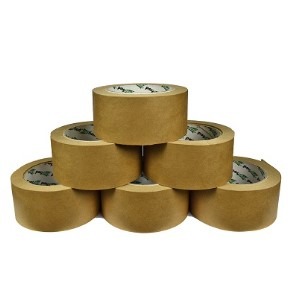
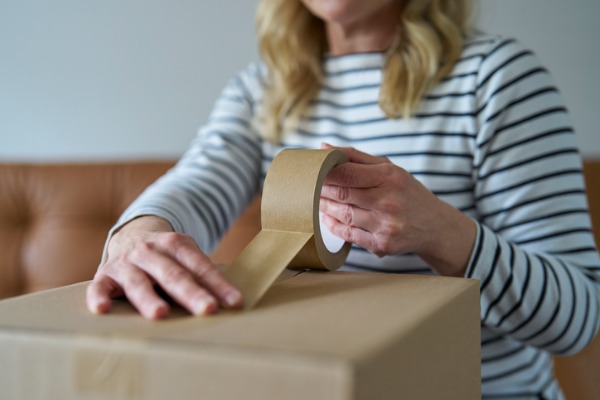
Brown kraft paper tape is a popular choice for eco-conscious packaging.
How Does Paper Tape Compare to Plastic Tape on Price?
Cost Per Roll at Small Quantities
At the smallest pack size, the price difference is already noticeable. A 6-roll pack of brown kraft paper tape (50mm x 50m) costs £2.16 per roll, totalling £12.95 for the pack, while a 6-roll pack of clear plastic tape (48mm x 66m) costs £0.83 per roll, totalling £4.95. The paper tape priced here is self-adhesive kraft tape. Water-activated gummed paper tape is priced separately.
Stepping up to a 12-roll pack, brown kraft paper tape drops slightly to £2.08 per roll (£24.95 total), while clear plastic tape falls to £0.75 per roll (£8.95 total). The relative gap stays roughly similar at this stage, with paper tape still costing close to three times as much per roll.
Cost Per Roll at Bulk Quantities
Buying in bulk brings the per-roll cost down for both tapes, but plastic tape's savings scale slightly faster.
-
At 72 rolls, paper tape costs £1.75 per roll (£126.00 total) versus plastic tape at £0.61 per roll (£44.00 total).
-
At 144 rolls, paper tape sits at £1.69 per roll (£244.00 total) while plastic tape drops to £0.55 per roll (£79.00 total).
By the largest tier the paper tape is listed in, 360 rolls, paper tape costs £1.61 per roll (£580.00 total) compared with £0.50 per roll (£180.00 total) for plastic tape, meaning paper tape costs around 3.2 times more per roll at this volume, a slightly wider gap than at the smallest pack size.
Plastic tape carries on past this point; a 720-roll pack brings it down to £0.47 per roll (£340.00 total).
Paper vs Plastic Packing Tape: Comparison Table
Seal Your Boxes Sustainably with Globe Packaging

Globe Packaging stocks both paper and plastic packing tape, with same-day dispatch.
Choosing between paper and plastic tape comes down to matching the tape to the job, whether that is a tamper-evident retail parcel, a damp warehouse floor, or a high-volume fulfilment line. Get the adhesive, backing, and pack size wrong, and you end up with split seams, rejected recycling, or an unnecessarily high bill at the end of the month.
At Globe Packaging, we stock paper tape in packs from 6 to 360 rolls and clear plastic tape in packs from 6 to 720 rolls, so you can compare them against your packing conditions rather than guessing. Browse our full tape range and order by 4pm for same-day dispatch and next-working-day delivery on UK mainland orders over £50 (exc VAT).
Frequently Asked Questions (FAQs)
Is paper tape better for the environment than plastic tape?
It depends on the adhesive, coatings, and local recycling facilities as much as the backing material. Paper tape's kraft backing can be processed alongside cardboard in some systems, while plastic tape usually needs to be separated first. The most sustainable choice considers the full packaging system, not just the tape.
Does water-activated tape work without a special dispenser?
Yes, but not as easily. The bond forms only once the glue is wet, so you must moisten the adhesive side with a damp sponge or cloth before the tape touches the carton. That works fine for occasional use, but a dedicated dispenser wets and cuts the tape in one pass and is far more consistent at volume.
Can you put plastic packing tape in recycling bins?
Plastic packing tape generally needs to be separated from the cardboard box before recycling, since BOPP film does not break down in standard paper pulping processes. Before binning a taped box, check whether your local council accepts mixed paper and plastic, and remove or at least loosen the tape from the cardboard.
It’s also worth looking for other plastic elements, such as a mailing bag or void fill, that need to be sorted separately.
Why is paper tape more expensive than plastic tape?
Paper tape costs more per roll mainly because of differences in materials and production. Roll length widens the gap further: Globe Packaging's paper tape rolls are 50 metres long, compared with 66 metres for clear plastic tape, so per metre, paper tape works out at roughly 3.5 to 4.3 times the cost of plastic tape, depending on pack size.
Does Globe Packaging sell both paper and plastic tape?
Yes. Globe Packaging stocks 60gsm brown kraft paper tape with a strong rubber adhesive and 48mm x 66m clear plastic packing tape. Both are sold in a range of pack sizes, from 6 rolls up to 360 rolls for the paper tape and up to 720 rolls for the plastic tape, with next-working-day delivery available on UK mainland orders over £50 (exc VAT). You can compare both in our packing tape range.
*Note: Product listings, prices, and delivery times shown are approximate and subject to change. Contact Globe Packaging for the latest information.
Related Articles
-resized-to-600x400.jpeg)
About Us
| Terms & Conditions | Delivery Services & Costs | Privacy Policy | Return & Exchanges | Payment | Testimonials | Overview | Video | E-Commerce | Amazon APass | PayPal Branded | Press | Catalogue | Learning | Contact | Sitemape-Commerce solutions by KOL Limited
All displayed prices are exclusive of VAT at 20%