Accept
 Reject



 0345 224 3691



 Enjoy the May Bank Holiday!
Price Match
We guarantee our prices are extremely competetive and should be the BEST prices you will find on-line, along with delivering the very best service. For this reason, we offer a price match against other on-line sellers. If you find the same product elsewhere on line, give us a call on 0345 224 3691 and we will match or even beat it! Note that the following conditions must be met for the price match to apply:
- The item must be available on a UK website at the advertised price, and readily available to purchase, with a like for like delivery offering.
-The item in question must have the same specifications, quantity and be produced by the same manufacturer - although we will usually price match even if made by a different manufacturer, as long as its a comparable quality.
- Auction sites such as ebay and amazon do not qualify for price match.
- The price match cannot be used in conjunction with any discount codes or promotional items.
- If there are pricing errors on competitors sites that are clear typographical pricing errors, these will not be matched.
- Note that for corrugated lines (boxes/cartons), the item must be of the same specification (fluting and thickness) and be unbranded.
Call us on 0345 224 3691 and we will be more than happy to help!
Packing Peanuts vs Packing Paper: Benefits, Use Cases & Price
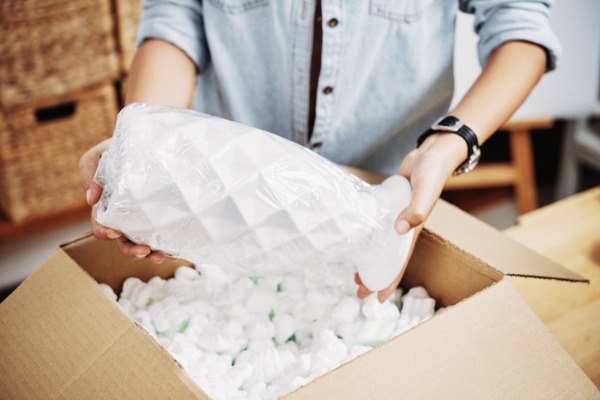
Key Takeaways
-
Packing peanuts excel at void fill, conforming around any shape and keeping items from shifting during transit.
-
Packing paper is more versatile, as it wraps, cushions, and fills, making it a go-to for fragile and irregularly shaped items.
-
Biodegradable packing peanuts like Ecoflo Ultra are 100% compostable, while packing paper is recyclable and reusable.
-
Packing peanuts are lightweight but bulky to store; packing paper stacks flat and is often cheaper per unit.
-
Globe Packaging stocks both packing peanuts and packing paper across a wide range of types and sizes.
Which One Is Better: Packing Peanuts or Packing Paper?
Neither one wins outright. Packing peanuts are built for void fill, keeping items suspended inside a box so they don't shift or collide. Packing paper wraps and cushions individual items, protecting surfaces from scratches, chips, and friction. The right choice depends on what you're shipping.
For many shipments, using both together yields the best results. Below, we break down how each material works, what it costs, and where it performs best so you can match the right packaging to every product in your lineup.



Overview of Packing Peanuts
Packing peanuts (also called loose fill or void fill) are small, shaped pieces of material designed to fill the empty space inside a shipping box.
That empty space is the enemy of safe shipping. Without it, items shift, knock against box walls, and arrive damaged. Packing peanuts solve this by conforming around products of almost any shape, creating a buffer that absorbs impact from every direction.
They come in two main material types: polystyrene (EPS) and biodegradable starch-based alternatives. Polystyrene packing peanuts are the traditional option: lightweight, highly effective, and widely available. The downside is that they're not environmentally friendly and can be a nuisance to clean up because of static cling.
Biodegradable packing peanuts, such as the Ecoflo and Ecoflo Ultra ranges from Globe Packaging, are made from maize starch and are 100% biodegradable and 100% compostable. They dissolve in water, leave no toxic residue, and perform surprisingly close to their polystyrene counterparts. The Ecoflo Ultra variant is specifically engineered for heavier applications, with a denser construction and high-performance compostable polymer that gives it the rebound characteristics typically associated with EPS foam.
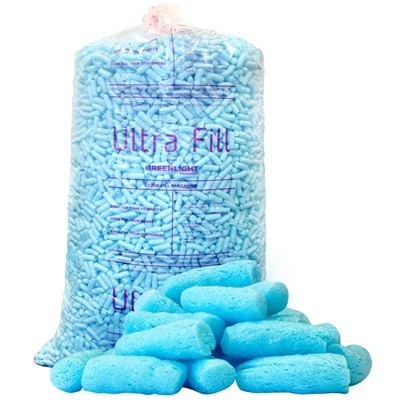
EcoFlo Ultra is 100% compostable and biodegradable.
Benefits of Packing Peanuts
The core strength of packing peanuts is their ability to completely and efficiently fill irregular void spaces. Unlike rigid inserts, they flow around your product and settle into every gap, providing 360-degree protection without any custom cutting or fitting.
They're also extremely lightweight, which helps keep shipping costs down when you're paying by weight. For businesses shipping high volumes of varied products, the weight saving adds up quickly. The mixed-colour Ecoflo biodegradable loose fill also doubles as a visually appealing presentation layer, which makes it popular in the fashion and gift industries where unboxing experience matters.
Price
At Globe Packaging, packing peanuts are available across three product lines. Ecoflo Biodegradable Loose Fill starts from £24.85 for 15 cubic feet. Ecoflo Ultra, the higher-performance option engineered for heavier applications, starts at £29.95 for 15 cubic feet and drops to £48.00 for 45 cubic feet. Ecoflo Mixed Colour Loose Fill, popular in the gift and fashion space, ranges from £38.95 to £102.00 depending on volume.
Best For
Packing peanuts are the best choice when you need to ship items that vary in size and shape, especially when those items need to be suspended inside a box without contact with the walls. They're ideal for e-commerce businesses handling diverse product ranges, manufacturers shipping components, and retailers in the gift or fashion space who want protective packaging that also looks good on arrival.
Overview of Packing Paper
Packing paper is exactly what it sounds like: sheets of paper used to wrap, cushion, and protect items during shipping or moving. But calling it "just paper" undersells what it actually does. The right packing paper absorbs shock, prevents surface scratches, and can be scrunched into void fill when needed, giving it a flexibility that packing peanuts simply can't match.
The most common type used in shipping and removals is white newspaper offcuts, also known as white packing paper or chipshop paper. It's unprinted, which means no ink transfer onto your products. It's also used in food wrapping applications, which speaks to its cleanliness and safety credentials.
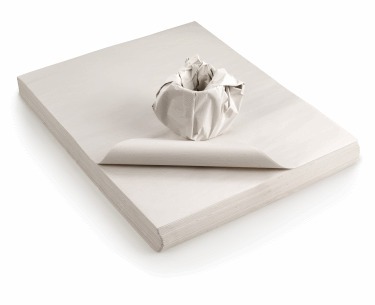
Packing paper works for different packaging purposes.
Unlike packing peanuts, packing paper stacks flat and stores easily. A ream of packing paper takes up a fraction of the warehouse space that a 15-cubic-foot bag of loose fill requires, making it a more practical option for businesses with limited storage.
Benefits of Packing Paper
Packing paper's biggest advantage is its versatility. It wraps individual items to prevent surface damage, scrunches into void fill to stop items shifting, and layers between stacked products to prevent contact and friction.
It's also fully recyclable and reusable, which is a genuine selling point for businesses and consumers becoming more conscious of packaging waste. Customers can flatten and recycle it at home without any special facilities, unlike polystyrene packing peanuts, which require dedicated drop-off points in many areas.
Price
At Globe Packaging, packing paper is sold as white newspaper offcuts in a standard 500x750mm sheet size, with pricing that rewards volume. A 100-sheet pack starts from £6.79, a single 10kg ream (600 sheets) is £18.95, and bulk orders scale down to as low as £12.82 per ream when buying 60 reams at £769.00.
Best For
Packing paper is the go-to choice for wrapping fragile items like glassware, ceramics, and electronic components, where surface contact protection is critical. It's also heavily used in the removals industry for exactly this reason. If your shipments involve items with delicate finishes, or you need a material that handles both wrapping and void fill without sourcing two separate products, packing paper is the practical, cost-efficient answer.
Packing Peanuts vs Packing Paper: Comparison Table
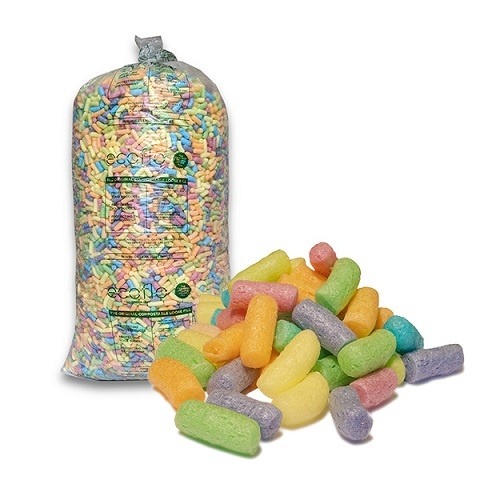
Both packing peanuts and packing paper can help protect your shipments.
Get Your Packing Peanuts and Packing Paper From Globe Packaging
At Globe Packaging, we stock both materials across multiple variants, from standard polystyrene loose fill to the full Ecoflo biodegradable range, as well as white newspaper offcuts for high-volume wrapping and void fill.
If you're scaling an e-commerce operation, running a removals business, or need reliable packaging delivered fast, we've got the stock and the range to keep your shipments protected. Get in touch or browse our full packaging range today.
Shop for packing peanuts and packing paper at Globe Packaging!
Frequently Asked Questions (FAQs)
Are packing peanuts or packing paper better for fragile items?
It depends on the type of fragility. Packing peanuts are better for keeping items suspended and isolated inside a box. Packing paper is better for protecting surfaces directly, wrapping individual pieces to prevent chips, scratches, or contact damage during transit.
Are biodegradable packing peanuts as effective as foam peanuts?
For standard applications, yes. Biodegradable packing peanuts, such as the Ecoflo range, perform comparably to polystyrene loose fill in most shipping scenarios. The Ecoflo Ultra specifically closes the performance gap even further, with a denser construction and a high-performance compostable polymer that gives it rebound characteristics similar to those of EPS foam. It's designed for heavier applications where standard biodegradable loose fill might compress too much under load.
The main practical difference is that biodegradable peanuts dissolve in water, so they require dry storage conditions.
Is packing paper safe for food-related products?
Yes. White newspaper offcuts (the standard packing paper used in shipping and removals) are unprinted and free from ink, which is precisely why they're used in food wrapping and general packaging. The absence of print is a key distinction from repurposed newspapers, which carry ink that can transfer to food surfaces.
Can packing paper replace bubble wrap?
For many applications, yes. Scrunched packing paper provides effective cushioning for most standard shipping scenarios and is often preferred by eco-conscious brands because it's easier for end customers to recycle. When layered or scrunched tightly around a product, white packing paper creates an effective shock-absorbing buffer that handles the bumps and drops of standard shipping conditions.
What other packaging materials are available at Globe Packaging?
Beyond packing peanuts and packing paper, Globe Packaging carries a comprehensive range of protective and shipping materials suited to everything from small parcel dispatch to large-scale industrial fulfilment. The full product range includes boxes, tapes, bubble wrap, stretch film, and specialist void-fill solutions, making Globe Packaging a single-source supplier for businesses looking to consolidate their packaging procurement without sacrificing quality or range.
*Note: Product listings, prices, and delivery times shown are approximate and subject to change. Contact Globe Packaging for the latest information.
Related Articles

-resized-to-600x400.jpeg)
About Us
| Terms & Conditions | Delivery Services & Costs | Privacy Policy | Return & Exchanges | Payment | Testimonials | Overview | Video | E-Commerce | Amazon APass | PayPal Branded | Press | Catalogue | Learning | Contact | Sitemape-Commerce solutions by KOL Limited
All displayed prices are exclusive of VAT at 20%